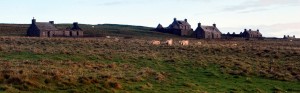
Stroma – Forming a Picture
Have you ever seen something at a distance and formed an impression of it, and then seen it close up and formed an entirely different view of it? People say that about my paintings. At a distance they see the entire scene and see the image of a bigger picture, but close up they see all the numerous, individual brush strokes that constitute the composition. Or perhaps how you see one of those collages of a portrait, but it is only when you are close up that you realise that the image is formed of much smaller pictures.
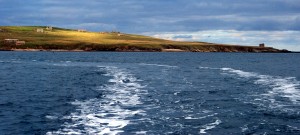
That was my experience last weekend as I ventured across to Stroma. Up to this point, my view of the island had been distanced and remote. I appreciated its beauty as a scenic point and had heard some stories about its history but I had not truly connected with it. I was yet to see the smaller parts that make up its greater whole.
After a day on the island I am now beginning to see it for what it is; a special place full of lives lived, memories made, roots established and homes lost but never forgotten. Any time spent on Stroma is remarkable. It is like stepping into someone’s home when they aren’t there and taking a peak at their way of life, except this way of life is not current but circa 1960. The last inhabitants, aside from the lighthouse family who stayed until 1997, left the island in 1962. Population had declined since a peak of 375 in 1901.
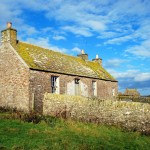
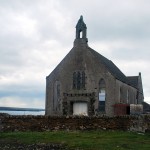
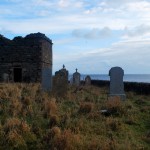
Each home tells a different story that we can only guess at. Objects remain as they were left. In one house, batteries, a sewing machine, a mattress. Shoes, a step ladder, a framed picture above the mantelpiece in another. Outbuildings deserted and Caithness Stone slabs still marking a garden that has long since been abandoned. Each derelict building adding to the larger picture of the island; the school house with its dusty books, the church with its steeple and windows still intact, the post office with its dried up ink. The red phone box, with its cracked glass and the rusting machinery piled together in centre of the island. The grave stones in the cemetery and the mausoleum once standing so proud and erect, now falling piece by piece to the ground. I could not helped but be touched by the poignancy.
I returned to the boat, full of questions un-answered, but was grateful to chat with a local man originally from the island, Simpson Crowe. 81 year old Simpson left aged 12 because he had to attend Wick High School. Tell me some stories, I ask, eager to put a person into the picture, to make it real.
“I remember eating a lot of fish”, he says in his soft accent, “We would salt it and dry it for 3 weeks in the outhouse. Everyone had outhouses. One winter, the storms were so strong and the water rose right up the beach and started coming in the house. My mother had to grab my younger brother and I and run up the hill as the sea was chasing us. And I remember one foggy day I saw a ship’s deck appearing just in front of me. I shouted ‘land ahoy’ and it swerved just in time to stop from hitting the rocks”.
Transported back to the mainland, I was left with a feeling of nostalgia. One day was not enough time to gather and to absorb the stories. How many lives have forever been touched and changed by this little island that lies just off our shores? How will nature and time converge to cover up these stories? I hope not, we have a gem in our midst and it is something we should celebrate. I am grateful for the chance to see Stroma up close, to form a picture from the smaller detail, not just from seeing it at a distance. How lucky are we to have it as another piece of the jigsaw that makes up this beautiful place of Caithness?